❝A dog has one aim in life… to bestow his heart.” ― J. R. Ackerley❞
❝A dog has one aim in life… to bestow his heart.” ― J. R. Ackerley❞
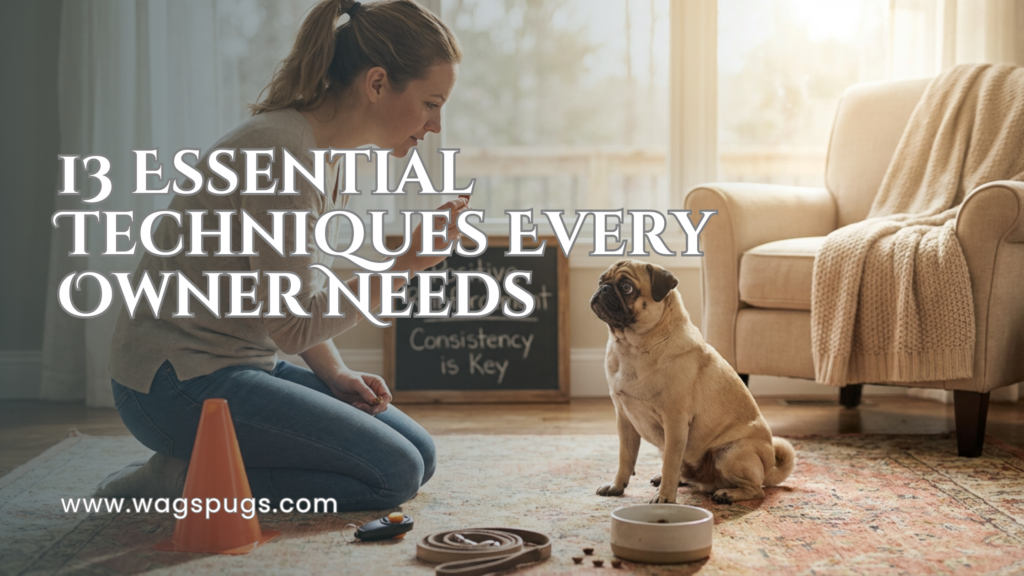
Pugs are wonderfully expressive, affectionate, and often hilariously dramatic. But beneath the charm lies a trait that many owners quickly discover: a strong streak of stubbornness. Before you can change behavior, you need to truly understand why your pug seems so resistant, selective, or “deaf” to commands.
Pugs were bred as companion dogs, not working dogs. Unlike herding or hunting breeds, who are genetically wired to follow direction and perform tasks, pugs are wired to bond. Their motivation is emotional connection, comfort, and reward, not blind obedience.
Several factors contribute to their stubborn reputation:
Instead of labeling your pug as “bad” or “disobedient,” it’s more accurate and more helpful to see them as a sensitive, reward-driven learner who needs structure, clarity, and motivation.
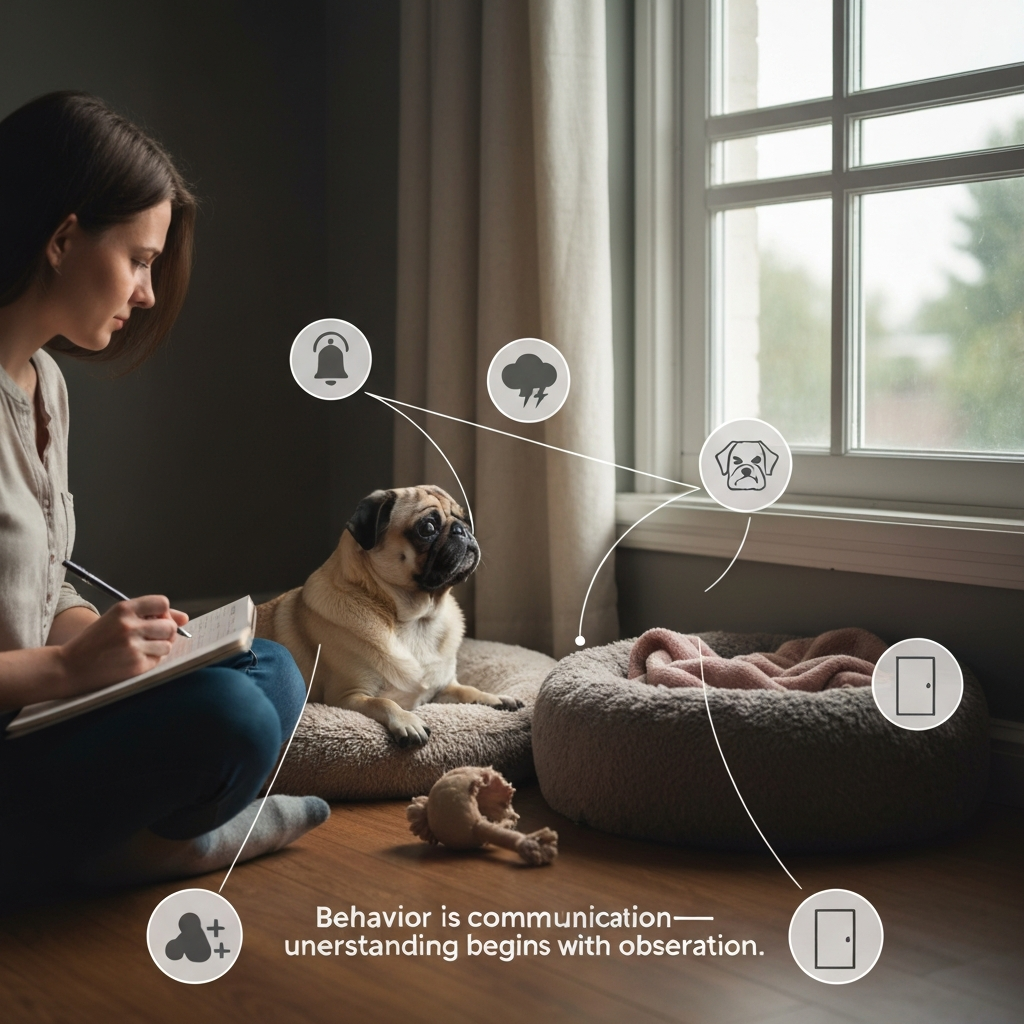
Just as with eye issues or health concerns, awareness and early recognition of behavior patterns are powerful tools. Before you jump into correcting your pug, it’s essential to take a short “observation period” where your main job is simply to watch, record, and understand.
Spend three to seven days simply watching your pug and making notes. You can even keep a small notebook or use your phone to jot down patterns that emerge. Ask yourself questions such as
To make this more relevant and useful, you can use a simple tracking table like the one below: Pug Training & Obedience Tips.
Situation/Context | What You Asked For | Pug’s Response | Possible Cause | Action Step for Training |
Indoors, quiet room | “Sit” | Responds quickly, holds position | Calm, low-distraction environment | Use this setting to teach new commands and build confidence. |
Backyard, birds and noises outside | “Come” | Ignores, continues sniffing | High distraction, low motivation | Use higher-value treats and a long line; start closer and build distance. |
After a long walk | “Down” | Slow response, seems uninterested | Physical fatigue, mental tiredness | Shorten sessions; train earlier in the walk or after a short rest. |
Guests arrive at the door | “Stay” | Jumps, barks, doesn’t listen | Over-excitement, emotional overload | Practice “sit” and “stay” with fake arrivals; reward calm behavior. |
During meal prep in kitchen | “Wait” | Whines, paces, struggles to hold position | High arousal due to food anticipation | Start with very short “waits,” reward often, and gradually increase duration. |
Busy street walk | Name + “Look at me” | Glances briefly, then looks away | Competing stimuli, mild anxiety | Reward every brief eye contact; move to quieter streets at first. |
This observational phase helps you distinguish between different emotional and cognitive states:
Many pug owners misinterpret stubborn behavior as defiance or dominance, but for pugs, refusal to listen is often an emotional response, not a behavioral decision. Because this breed is highly sensitive to tone, energy, and environmental stress, your pug’s emotions influence obedience more than commands do. Learning to recognize emotional triggers allows you to prevent stubbornness instead of battling against it.
Pugs react strongly to:
the sound of your voice
frustration in your tone
tension in your body language
changes in environment
loud noises
unfamiliar people
overstimulation
When a pug feels overwhelmed or uncertain, obedience becomes harder. When your pug feels calm and emotionally safe, cooperation increases dramatically.
This means that you should always assess your pug’s emotional state before correcting behavior, just as you wouldn’t treat symptoms without first determining the cause of a pug eye problem.
Look for these common emotional cues:
sudden avoidance of eye contact
tail tucked or posture lowered
ignoring commands they normally obey
refusing treats
yawning or licking lips repeatedly
whining or pacing
hiding behind furniture or behind you
Each of these reflects emotional overload, not intentional disobedience.
Use this table to help identify patterns:
Emotional Trigger | How a Pug Typically Reacts | Possible Cause | What You Should Do |
Loud voices or yelling | Leaves the room, freezes, or shuts down | Emotional pressure or fear | Lower your tone; keep instructions gentle and calm |
Busy environment | Ignores commands, sniffs nonstop | Sensory overload | Move to a quieter space and reward focus |
New dogs or people | Overexcitement or anxious whining | Social sensitivity | Keep distance, reinforce calm behavior |
Owner frustration | Slow response, avoidance | Sensitive to tone and energy | Take a break; restart with calm voice |
Sudden noises | Startles, barks, runs toward or away | Instinctive alert response | Reward calmness, redirect attention |
Heat or fatigue | Refuses commands, lies down | Brachycephalic breathing difficulty | Shorten sessions, give water and rest |
Unfamiliar settings | Inattention, hesitation | Uncertainty and caution | Begin training in familiar spaces first |
Positive reinforcement is the emotional engine of effective pug training. When used properly, it turns training from a struggle of wills into a happy, fulfilling partnership.
One of the most misunderstood aspects of pug training is the concept of motivation. Many owners assume their pug “knows what to do” and is simply refusing. In actuality, unless your reward is emotionally potent, pugs will always choose whatever feels most satisfying at that particular moment. Comfort, curiosity, or environmental excitement frequently outweigh your single command.
High-value rewards change that equation instantly.
Your goal is to make listening to you more rewarding than ignoring you. Indeed, pugs are fully capable of making that change.
Pugs are naturally food-motivated, but their motivation depends heavily on how special (not just how tasty) a treat is.
When a reward feels special, your pug experiences:
increased attention
higher drive
better focus
faster learning
more willingness to obey
additional “What should I do?” behavior
This emotional excitement transforms stubborn behavior into engaged cooperation.
Reward Type | Value Level | Best Use Case | Example Items | Emotional Result |
Regular kibble | Low | Calm indoor sessions | Dry kibble pieces | Mild interest |
Standard treats | Medium | Maintenance training | Crunchy treats | Steady cooperation |
High-value treats | High | Important or difficult training | Chicken, cheese, liver | Strong motivation, happy focus |
Jackpot reward | Very high | Major success moments | Large treat piece | Emotional excitement, memory imprint |
High-value treats start the learning process, but praise builds long-term obedience. Treats activate immediate motivation; praise activates emotional bonding, which is essential for pugs. Over time, praise gradually replaces treats as the main reward, and this transition is the key to preventing treat dependency.
Pugs listen best to people they feel emotionally connected to. Therefore, they become more naturally cooperative the more positive affection and approval they associate with obeying your instructions.
For a stubborn pug, listening feels optional unless a reward is emotionally meaningful. While praise offers long-lasting motivation, treats offer immediate motivation:
When combined correctly, your pug learns:
I feel good and my human is happy when I do this.
That emotional reinforcement becomes stronger than food alone.
Reward Type | Purpose | How Fast it Works | Motivational Strength | Emotional Benefit | Used Long-Term? |
Treat only | Temporary motivation | Fast | High | Medium | No (fades) |
Praise only | Emotional support | Slow | Medium | High | Yes |
Treat + Praise | Ideal reinforcement | Fast | Very High | Very High | Yes—most effective |
The combination is how stubborn pugs move from “Why should I?” to “Of course!”
Praise becomes especially powerful when:
Eventually, praise becomes enough on its own—especially in calm settings.
Once your pug consistently responds:
This way:
Your pug eventually works for your approval, not just snacks.
One of the most important yet frequently overlooked elements of pug training is the duration and pacing of each session. Due to their naturally short attention span and emotionally sensitive temperament, pugs learn most effectively when training sessions are intentionally brief and repeated multiple times per day rather than conducted in long, continuous blocks.
Extended sessions often result in frustration, distraction, or a perceived unwillingness to participate. In reality, what many owners interpret as stubbornness is more accurately described as mental overload. Pugs automatically disengage when their cognitive capacity is exceeded; this is not because they are disobedient, but rather because they can no longer concentrate.
Limiting training duration yields the following benefits:
In short, shorter sessions preserve the pug’s emotional stability, which is essential for sustained learning and long-term behavioral reliability.
The most effective training plan varies based on age, energy levels, and cognitive development. The table below provides a professional reference for optimal session duration and frequency:
Life Stage | Recommended Session Length | Ideal Frequency | Suggested Timing |
Puppy (8–16 weeks) | 1–3 minutes | 3–5 sessions/day | Morning, midday, evening |
Adolescent | 3–5 minutes | 3–4 sessions/day | After light activity |
Adult | 5–7 minutes | 2–3 sessions/day | Before meals and early evening |
Senior | 2–4 minutes | 2–3 sessions/day | Morning and early afternoon |
These brief, structured intervals ensure that learning remains enjoyable rather than stressful.
Training effectiveness depends heavily on timing and environment. Avoid training when your pug is:
Instead, choose calm, predictable periods where concentration is most likely.
Clicker training is a research-supported conditioning method that offers particularly strong benefits for pugs due to their sensitivity to immediate feedback and their tendency toward selective attention. This technique relies on a small mechanical device—the clicker—to mark the exact moment a desired behavior occurs, providing your pug with a clear, consistent signal that reinforces the correct action. When applied correctly, clicker training significantly improves learning speed, response accuracy, and long-term behavioral reliability.
Unlike voice-based praise, which naturally varies in tone and emotional delivery, the clicker provides a neutral and consistent auditory marker, ensuring that reinforcement is communicated with precision. This method is valuable for pugs for several reasons:
Clicker feedback is objective, immediate, and clear—essential qualities when working with a breed known for occasional stubbornness and emotional sensitivity.
The following table summarizes the functional differences between the two primary reinforcement markers used in dog training:
Marker Type | Timing Precision | Tone Consistency | Appropriate Use | Effectiveness for Pugs |
Verbal markers (“Yes,” “Good”) | Moderate | Variable | Basic positive reinforcement | Effective |
Clicker device | High | Consistent | Precision learning and shaping | Highly effective |
Although verbal praise remains valuable, clickers offer superior reliability, particularly for pugs who benefit from explicit, predictable cues.
Clicker-based methods are particularly advantageous when teaching:
Because the click precisely identifies correct behavior, pugs can learn and repeat commands with significantly reduced confusion.
Once a behavior becomes consistent and reliable, the clicker should be gradually phased out. The objective is for the pug to internalize the behavior rather than depend permanently on external markers. To keep motivation high, treat frequency should be gradually decreased while verbal praise and sporadic rewards are still given.
Treats are essential during the early stages of training, particularly for pugs, who are strongly motivated by food-based rewards. However, long-term behavioral success depends on transitioning from continuous treat reinforcement to a balanced combination of verbal praise, emotional encouragement, and occasional rewards. This process is known as “fading,” and it ensures that your pug obeys commands reliably even when treats are not presented.
The objective is not to eliminate food reinforcement entirely but to strategically reduce treat frequency while strengthening praise and emotional bonding, ultimately preventing dependency and promoting genuine obedience.
A common challenge among pug owners is that their dog responds well only when food is visible. This occurs when food is used as a bribe rather than a reinforcement tool. Treat-fading prevents this issue by teaching your dog to perform behaviors because they understand the request—not because they are constantly expecting a treat.
Key benefits include:
In essence, fading transforms obedience from a transactional behavior into a learned habit.
Treat reduction should always be implemented methodically and gradually to preserve clarity and prevent frustration. A recommended progression protocol includes the following stages:
Throughout this process, verbal praise remains constant, ensuring that emotional reinforcement remains strong even as edible rewards become less frequent.
Training Stage | Reward Frequency | Best Use Case | Expected Outcome |
Continuous | Every success | New behaviors | Fast learning, clear association |
Intermittent | Every 2–3 successes | Moderate skill levels | Strengthened reliability |
Variable | Random successes | Advanced stages | Increased attention and consistency |
Maintenance | Occasional | Lifelong reinforcement | Sustained obedience |
This gradual transition encourages consistent performance regardless of visible threats.
Because pugs are vulnerable to weight gain, treat reduction also serves an important health function. When fading treats:
This balanced approach protects your pug’s health while reinforcing desired behavior.
Over time, your pug should learn to respond primarily to your voice, tone, and emotional encouragement rather than the promise of food. Pugs are extremely perceptive and form strong emotional bonds, making praise and affection highly effective motivators once behaviors become habitual.
Examples of emotional reinforcement include:
These forms of reinforcement satisfy your pug’s natural desire for connection, making obedience far more consistent.
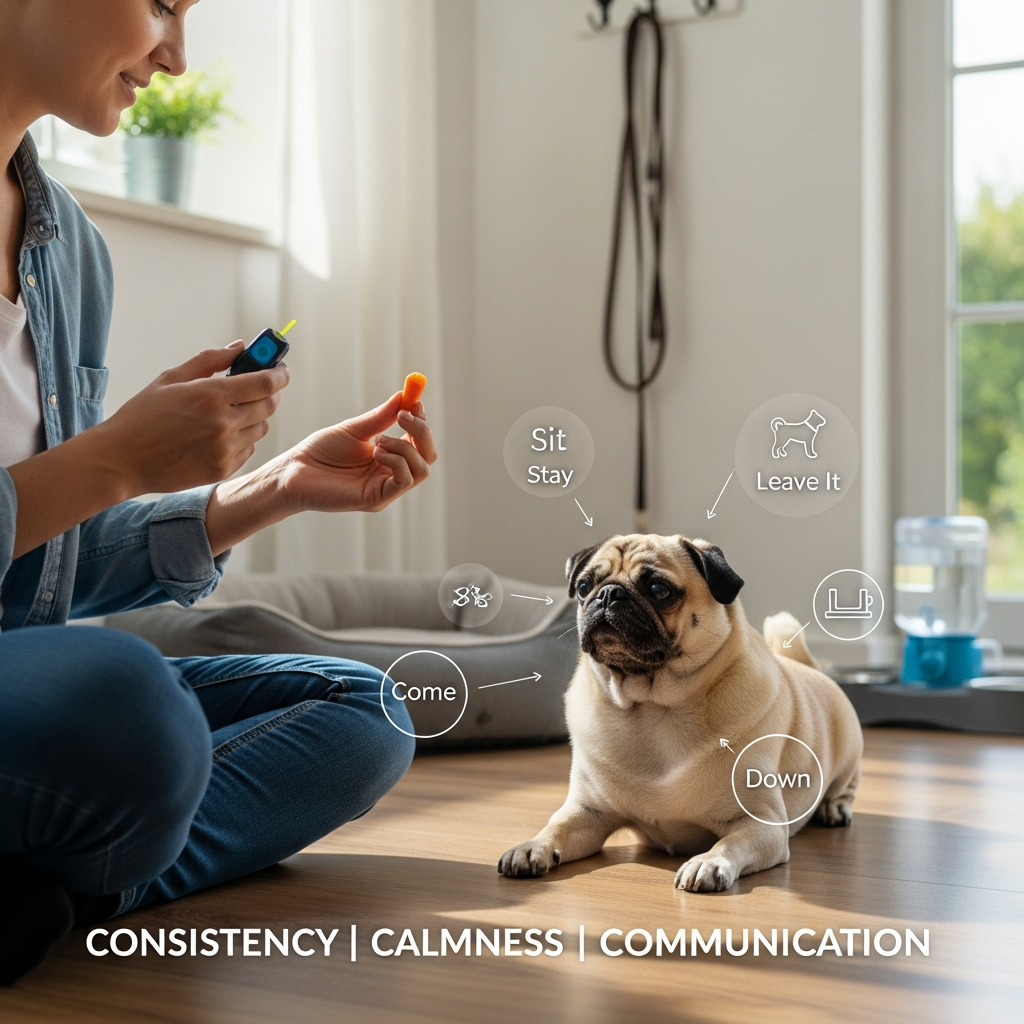
Once you understand motivation and reinforcement, it’s time to apply structured training techniques. These are your “daily care routines” for behavior: sit, stay, come, walk nicely, and settle.
Among all obedience commands, “sit” remains the most important and foundational skill for pugs. This cue creates structure, reinforces calm behavior, and builds impulse control. The ability to sit on command offers instant behavioral control in a variety of real-world situations because pugs are inherently gregarious and enthusiastic, particularly around food, family activities, or guests.
Unlike more advanced commands, “sit” functions as a universal calming signal. Professionally speaking, a dependable “sit” is more than just a simple trick; it is a behavioral default that reinforces good manners during daily activities and gets your pug ready for commands like “stay,” “wait,” or “leave it.”
From a behavioral standpoint, “sit” offers numerous advantages:
Pugs benefit greatly from predictable structure, making this command central to training success.
A professionally structured approach includes:
Over time, your pug will associate the verbal cue with the physical action.
Phase | Training Objective | Handler Action | Expected Outcome |
Introduction | Teach initial movement | Use a treat to entice | Pug lowers hips |
Reinforcement | Add verbal cue | Say “Sit” at the moment hips touch | Association formed |
Repetition | Increase confidence | Practice multiple times per day | Faster response |
Generalization | Expand environment | Practice in different rooms | Behavior becomes reliable |
As reliability increases, gradually reduce treats while maintaining praise.
Once established, the “sit” command becomes your primary behavioral management tool, especially during situations involving excitement or impulsivity. Use “sit”:
These repeated applications help your pug understand that polite sitting leads to positive outcomes.
After mastering “sit,” the next essential obedience behavior for a stubborn pug is a consistent, stable “stay.” While “sit” functions as an initial control, “stay” extends that impulse control and enables your pug to remain still during potentially distracting or risky situations. A well-trained “stay” command provides emotional structure, reduces impulsive reactions, and significantly enhances real-life safety.
Teaching pugs to pause and maintain their position in the face of intriguing stimuli is essential because they are inherently curious and easily excited. With proper reinforcement, “stay” becomes a calming anchor that prevents unwanted movement, excessive jumping, or uncontrolled behavior.
A reliable “stay” is especially important for pugs who may:
In these situations, “stay” acts as a protective boundary, preventing dangerous behavior and keeping your pug under safe control.
A structured training sequence includes:
Always return to your pug to deliver the reward during early stages—this reinforces holding position rather than breaking the stay to seek reinforcement.
Training Stage | Handler’s Action | Duration | Distance | Reward Method |
Initial learning | 1–2 second stay | Minimal | Close proximity | Immediate treatment |
Early progress | 3–5 seconds | 2–4 steps away | Return and reward | |
Intermediate | 5–10 seconds | Several feet away | Intermittent reward | |
Advanced | 15+ seconds | Praise and occasional | Praise and occasional |
This systematic progression prevents frustration while gradually strengthening reliability.
Once your pug holds a “stay” during calm indoor sessions, gradually introduce real-life variables:
By using generalization, you can make sure your dog knows that “stay” doesn’t only mean in the living room.
A dependable recall, commonly referred to as the “come” command, is one of the most important safety-related skills for any pug. This command ensures that your dog returns to you immediately when requested. The recall command shields pugs from potentially dangerous situations because they are inquisitive, gregarious, and easily distracted by intriguing movement or scents.
More importantly, recall reinforces cooperative behavior and strengthens the relationship between you and your dog. When a pug learns that coming back to you leads to positive interaction, the bond deepens and trust grows naturally.
Pugs often explore independently without understanding danger. A strong recall can prevent situations such as the following:
Because many pugs have limited impulse control by nature, recall helps you regain immediate control whenever needed.
This pattern teaches your pug that coming to you always results in something excellent.
Stage | Location | Distraction Level | Reward Type | Expected Outcome |
Beginner | Indoors | Very low | High-value treat | Initial learning |
Intermediate | Backyard or fenced area | Moderate | Treat plus praise | More reliable behavior |
Advanced | Public or busy area | High | Praise with occasional treat | Long-term reliability |
Progress slowly from one stage to the next. Keeping calm expectations helps prevent frustration and confusion.
Never use the recall command to end enjoyable activities, such as playtime, outdoor fun, or social interactions. When recall becomes associated with negative or unwanted outcomes, your pug begins to ignore the command completely.
Instead, call your pug, reward the response, then allow play or freedom to continue whenever possible. This encourages a positive emotional association with coming directly to you.
Pulling on the leash is one of the most common frustrations reported by pug owners. Since pugs are naturally curious and easily excited by outdoor environments, they often rush toward scents, sounds, or moving objects without realizing they are dragging their handler behind them. Teaching calm, loose-leash walking is essential for safety, comfort, and enjoyable daily walks.
Rather than forcing a pug to walk beside you by pulling or correcting harshly, loose-leash walking teaches the dog that staying close is both rewarding and comfortable. This approach reduces pressure on the neck and avoids discomfort for a brachycephalic breed that already faces breathing challenges.
There are numerous important advantages to teaching appropriate leash manners, including:
Good leash habits also set the foundation for polite behavior in busy or stimulating public areas, which can otherwise overwhelm a sensitive pug.
Follow these steps during early training:
Stopping movement when tension appears teaches your pug that forward progress requires a relaxed leash.
Training Stage | Environment | Leash Tension Goal | Handler Action | Reward Type |
Beginner | Indoors | Minimal tension | Mark focus and reward | Small treat |
Intermediate | Backyard or driveway | Short distance | Stop for any pulling | Treat plus praise |
Advanced | Quiet neighborhood | Longer distance | Pause if tension appears | Praise with occasional treat |
Gradually increase walking distance as your pug shows consistent cooperation.
Pugs are highly sensitive and respond poorly to force. Pulling on the leash, yelling, or correcting harshly often causes anxiety and confusion. Over time, punishment creates resistance rather than cooperation. Positive reinforcement produces far better long-lasting results and keeps your dog emotionally connected to you during outdoor activity.
Many pug owners hesitate to use crates because they worry it might feel restrictive. In reality, when introduced correctly, crate training provides a secure resting space and supports healthy emotional development. Pugs naturally seek cozy resting areas and often feel more secure in a small, familiar space than in a wide-open room.
Crate and settle training teaches your pug how to relax safely, reduce overexcitement, and build comfort with brief periods of separation. These skills help prevent anxiety, excessive barking, and unwanted behaviors that often occur when a pug feels overstimulated or unsure of what to do.
There are several benefits to crate training, including:
For a breed that bonds deeply with their owners, these structured habits reduce emotional stress over time.
Follow these steps to introduce the crate positively:
The goal is to make the crate feel like a cozy, rewarding resting place rather than a confinement space.
In addition to crate training, teaching a calm “settle” command on a mat or dog bed helps control overstimulation.
Over time, your pug learns how to shift from excited energy to calm behavior using a clear emotional pathway.
Training Goal | Location | Handler Action | Reward Method | Expected Outcome |
Initial curiosity | Crate open | Toss treats inside | Immediate reward | Positive association |
The crate | The crate | Reward quiet moments | Small treat | Relaxation |
Longer duration | Crate time after play | Reward calm behavior | Praise with occasional treat | Independence |
Settle into a routine | Mark’s | Mark’s | Verbal praise | Emotional self-regulation |
This progression builds confidence and teaches your pug how to relax naturally.
Never send your pug to the crate during moments of frustration. A crate must remain a safe and comfortable space, not a consequence for unwanted behavior. Using it as punishment causes anxiety and prevents your pug from settling calmly.
Always guide your pug gently and focus on positive reinforcement.
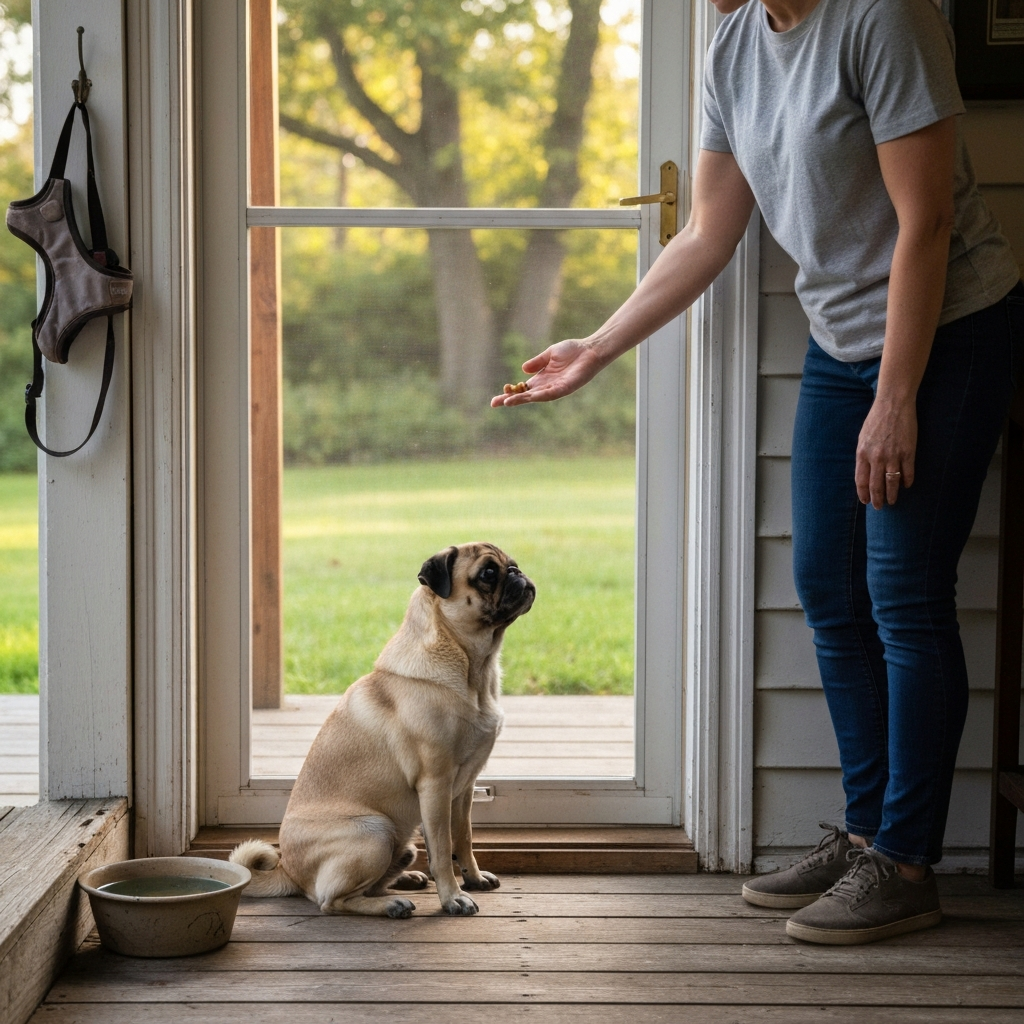
Even with solid obedience, real life with a stubborn pug brings specific challenges. Let’s tackle the most common issues with practical, emotionally sensitive techniques.
Even well-trained pugs may show moments of impulsive behavior, especially barking, jumping on guests, or suddenly “forgetting” commands outdoors. These behaviors often come from emotional excitement rather than intentional disobedience. Instead of reacting with frustration, the most effective approach uses calm structure, predictable expectations, and controlled reinforcement.
Managing these issues early prevents habits from becoming long-term problems and promotes confident behavior in busy home environments.
The most frequently reported concerns include:
Each behavior has a clear training solution once you understand the emotional trigger behind it.
When outdoors, pugs experience far more stimulation, which is why selective listening often appears during walks or yard time. The solution is short recall sessions using very high-value rewards in gradually more distracting locations.
Begin in the house, progress to the backyard, and eventually move to a calm outdoor space. Consistent success builds reliability and reduces selective behavior.
Behavior | Likely Cause | Professional Response | Desired Outcome |
Barking at noises | Excitement or alerting | Redirect attention | Quiet focus |
Jumping on guests | Social enthusiasm | Reward calm posture | Controlled greeting |
Ignoring outdoors | Environmental distraction | High-value recall work | Consistent response |
Pulling toward people | Social curiosity | Loose leash routine | Calm approach |
Barking at dogs | Overarousal | Distance and calm reinforcement | Reduced reaction |
This structure provides a clear pathway from undesirable behavior to calm cooperation.
Do not attempt long correction periods. Instead, use short redirections and end with positive reinforcement. Pugs learn far better when emotional balance is maintained and calmness is consistently rewarded.
Harsh corrections usually increase anxiety, which leads to more barking or stubborn behavior. Gentle, predictable guidance teaches your pug how to make better choices instead of reacting impulsively.
Managing a stubborn pug effectively is not about winning a battle. It’s about establishing a long-term relationship founded on emotional intelligence, structure, and trust.
Adopt a Calm, Coaching Mindset
Think of yourself less as a “boss” and more as a coach:
This mindset keeps your energy grounded and patient, which is exactly what a sensitive breed like the pug needs.
Make Consistency Your Secret Weapon
Behavior, like eye health, responds best to proactive, consistent care. Your pug will flourish when:
Ask for “sit” before meals, “wait” at doors, “come” in safe environments, and “settle” when things get too busy. These micro-moments reinforce obedience without needing long formal sessions.
Watch for Stress and Adjust Gently
If your pug’s stubbornness suddenly increases, consider:
Sometimes the best training choice is to pause, shorten the session, or go back to easier tasks so your pug can win again. Emotionally overwhelmed dogs do not learn well.
Finally, remember that training is not a one-time project; it’s a continuous conversation over your pug’s lifetime. Regularly:
A well-trained pug is not just obedient; they are confident, secure, and deeply bonded to you. Your calm leadership, clear communication, and compassionate reinforcement give them an emotionally safe “framework” to live in.
A stubborn pug is not a problem to solve but a personality to understand and guide with patience, empathy, and consistent structure. Their independence, sensitivity, and occasional selective listening are all part of what makes them so endearing. Pugs are much more willing to participate in training when it is approached with calm confidence instead of frustration. What may feel like resistance is often confusion or overwhelm, and responding with reassurance helps your pug feel safe enough to learn.
By applying the thirteen techniques shared throughout this guide, training becomes a clear and supportive process rather than a source of stress. These methods focus on positive reinforcement, consistent routines, clear communication, and gentle correction, all of which align naturally with a pug’s emotional nature. Progress may not always be immediate, but small improvements build steadily when expectations remain fair and consistent.
Over time, your pug will develop better manners, stronger confidence, and an increased willingness to cooperate. Training sessions become moments of connection instead of confrontation. Trust grows through repetition and understanding, strengthening the bond between you and your dog. With patience and commitment, you are not simply shaping behavior. You are building a relationship grounded in respect, security, and mutual understanding that supports a happier, more harmonious life together.
Pugs are intelligent dogs, but they are known for being stubborn and easily distracted. This does not mean they are untrainable, only that they require patience and consistency. They respond best to positive reinforcement rather than force. Training works well when sessions are calm, encouraging, and predictable.
Training should begin as early as possible, ideally when your pug is still a puppy. Early training helps establish boundaries and good habits before stubborn behaviors set in. Short, gentle sessions are best at this stage. Early socialization also plays a major role in long-term obedience.
Pugs are independent thinkers with strong personalities. They often prefer doing things their own way, especially if food or comfort is involved. This stubbornness is part of their charm, but it requires consistency in training. Clear expectations and routine help reduce resistance.
Yes, pugs are extremely food motivated. Small, healthy treats are often the most effective training rewards. Treats should be used strategically and in moderation. In order to prevent overfeeding, praise and affection should also be included.
Pugs have short attention spans, so training sessions should last five to ten minutes. Short sessions prevent frustration and keep your pug engaged. Multiple brief sessions throughout the day work better than one long session. Ending on a positive note encourages cooperation.
Pugs are capable of learning basic commands like “sit,” “stay,” “come,” and “down.” Progress may be slower than with some breeds, but consistency makes a big difference. Repetition and routine help reinforce learning. Patience is key to success.
Crate training can be very beneficial when done correctly. It helps with house training and offers security and structure. The crate should always feel safe and comfortable. Never use it as punishment.
Leash pulling is common in pugs, especially when they are excited. Stop walking when pulling occurs and reward calm behavior. Consistent practice teaches your pug that pulling does not lead to progress. Proper harnesses can also help.
Yes, older pugs can absolutely be trained. While learning may take longer, consistency still produces results. Training can improve behavior and mental stimulation at any age. Gentle methods work best for senior dogs.
Setbacks are normal and should not be viewed as failure. Calmly review basic commands and reinforce routines. Avoid punishment, which can cause confusion or fear. Patience and consistency usually resolve setbacks over time.
Particularly for new owners, training sessions can be quite beneficial. They provide structure, socialization, and professional guidance. Group environments also help pugs learn to focus despite distractions. Choose classes that emphasize positive reinforcement.
Punishment is not recommended for pug training. It can damage trust and increase stubborn behavior. Positive reinforcement builds confidence and cooperation. Calm correction and redirection are far more effective.
Training is an ongoing process rather than a fixed timeline. Basic obedience may take several weeks to establish. Throughout your pug’s life, you should continue to reward good behavior. Consistency matters more than speed.